

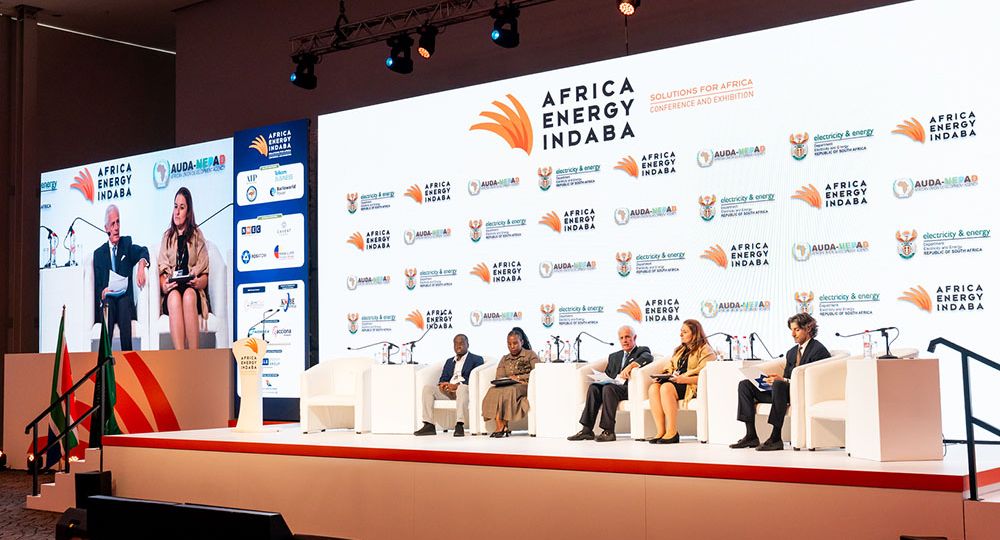
UNIDO hosted a high‑level plenary session on the Impact of Global Events on Energy Decarbonisation in Africa at the 2026 Africa Energy Indaba (AEI), held at the Cape Town International Convention Centre on 3 – 4 March 2026.
The AEI is one of Africa’s premier energy platforms, drawing policymakers, ministers, investors, utilities, industry leaders and media representatives from across the continent and abroad.
Ms. Karin Reiss‑Haimbala participated in the UNIDO-hosted plenary discussion alongside the Honourable Dr. John Abdulai Jinapor, Minister of Energy and Green Transition of Ghana, and the Honourable Ms. Yeukai Simbanegavi, Deputy Minister of Energy and Power Development of Zimbabwe. The session was moderated by Sean Cleary, Chairman of Strategic Concepts.
The plenary underscored that Africa’s industrialisation trajectory must be grounded in clean energy deployment at scale, resilient and modernised electricity systems, and green, regionally integrated value chains. Ms. Reiss-Hambala’s inputs were subsequently featured in the publication Engineering News in an article titled “Cutting carbon emissions requires green industrialisation” – https://m.engineeringnews.co.za/article/cutting-carbon-emissions-requires-green-industrialisation-2026-03-03
The piece was also picked up by other publications and amplified on social media platforms, highlighting the following key messages:
- Global emissions targets cannot be met without green industrialisation.
- Africa stands to benefit from COP30 outcomes, including increased climate‑finance commitments and the Belem Declaration on Green Industrialisation.
- UNIDO plays a critical role in strengthening policy coherence, building institutional capacity, and ensuring Africa is not left behind in emerging global standards (e.g., defining “green steel”).
- Climate finance is increasingly available, but stronger national enabling conditions are required to unlock it. The discussion reinforced that global megatrends – rising energy demand, supply‑chain realignments, and strengthened climate commitments – require African governments to prioritise green and competitive industrial transformation.
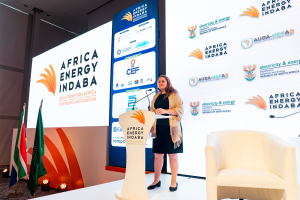
UNIDO also participated in an NCPC‑SA side event at the AEI on the topic Industrial Spaces as Sustainable Energy Hubs.
In her keynote address, Ms. Reiss‑Haimbala highlighted that industrial sectors account for roughly 30% of global emissions, underscoring the urgency of decarbonising Africa’s manufacturing base. She emphasised the potential for industrial parks and zones to evolve into integrated clean‑energy ecosystems, enabled by renewable energy deployment, clean‑technology value chains, and climate‑resilient infrastructure. However, fragmented infrastructure and persistent energy‑security challenges continue to constrain investment – calling for stronger policy alignment and coordinated planning frameworks.
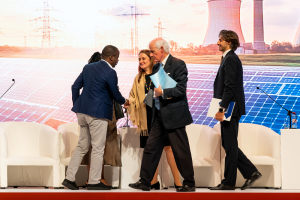
The NCPC-SA event included a panel discussion under the title: Investment in energy generation and sustainable energy models around industrial spaces – is there an enabling policy landscape, and what needs to be done. Mr. Mchenge Nyoka, National Project Coordinator at UNIDO’s Regional Office for Southern Africa, participated in the panel, jointly with representatives from NCPC‑SA, GreenCape, and the CSIR Energy Centre. Mr. Nyoka addressed the following:
- Renewable‑energy implementation models and their suitability for industrial spaces
- Existing regulatory and policy bottlenecks and opportunities for reform
- Infrastructure requirements to scale embedded generation and hybrid energy systems
- The funding gap in project preparation, and
- Municipal‑level grid constraints affecting project implementation.
The panel explored investment models, enabling‑policy needs, local‑grid challenges, and what is required to accelerate implementation. These perspectives reinforced the broader message that collaboration, coordination, and demand‑driven interventions are essential to unlocking sustainable industrial energy solutions.
Conclusion
Across both engagements at AEI 2026, one message was consistently reinforced:
Africa’s industrial future must be powered by clean‑energy systems, aligned and coherent policy frameworks, and strong multisector partnerships to attract climate finance and catalyse green industrialisation.
UNIDO will continue to work closely with government partners, industry stakeholders, and regional institutions to advance integrated solutions that drive industrial decarbonisation, build competitive and climate‑resilient value chains, and support Africa’s long‑term sustainable development goals.
High-level plenary session at the Africa Energy Indaba, hosted by UNIDO

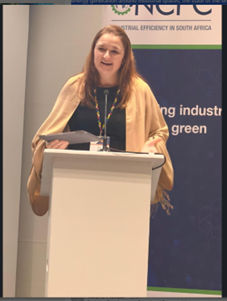
NCPC-SA side event on Industrial Spaces as Sustainable Industrialisation Hubs


